Herringbone Tile Pattern: Stunning Features, Layouts & Applications
1. What Is Herringbone Tile?
Herringbone tile is a common name for a herringbone layout in which rectangular tiles are set at alternating angles to form a continuous zigzag pattern that resembles a fish skeleton.
One of the advantages of herringbone is that the tile itself does not have to be elaborate. Even a solid-color tile can make a strong visual impact when the layout is done well. For a balanced finished surface, however, you need to consider tile size, layout direction, color, grout joints, and how the pattern will terminate at walls and edges.
In practice, herringbone is not really a separate type of tile. In most cases, the term refers to the way tiles are arranged in a herringbone pattern.
The tiles are typically rectangular. During installation, the end of one tile meets the side of the next at a right angle. Repeating this arrangement creates a continuous zigzag across the surface.
Many materials can be used to create a herringbone pattern. Common options include ceramic, porcelain, wood-look tile, subway tile, and natural stone cut into narrow rectangular pieces.
Compared with a straight lay, the main difference is tile direction. A straight lay creates parallel rows, while herringbone continuously changes direction. As a result, the grout joints become part of the visual pattern rather than simply the gaps between tiles.
2. What Makes Herringbone Tile Stand Out?
2.1. Adds Rhythm and Visual Depth
Because the tile direction changes continuously, the surface feels more dynamic. On a large floor, this breaks up the monotony that can come with horizontal or vertical layouts. That is also why herringbone is often chosen when homeowners want the floor or wall to play an active role in the design instead of simply serving as a backdrop for the furniture.
The pattern can draw the eye along the length or width of a space. In a long hallway, for example, aligning the herringbone with the main axis can emphasize the depth of the corridor. This effect depends heavily on the layout, though. If the pattern direction does not work with the shape of the room, the surface can feel busy. For that reason, establish the main layout axis before installation begins.
2.2. Creates a Focal Point Without Using Multiple Colors
One clear advantage of herringbone is that a single tile color is enough to create a visible pattern.
For example, white subway tile can look fairly simple in a straight lay. Switch it to herringbone, and the tile direction and grout joints create the visual interest. This makes the layout a good fit for spaces that need a focal point without introducing too many colors.
2.3. Works With Many Design Styles
Brown wood-look tile in a herringbone layout can bring to mind traditional wood flooring. White or beige subway tile, on the other hand, works well in bright, uncluttered spaces. Blue, gray, or black tile creates stronger contrast and is often used on kitchen backsplashes, in bathrooms, or on accent surfaces.
The same layout can therefore create a very different finished look depending on the material and color.
3. Ways to Lay Herringbone Tile
3.1. Classic Herringbone
This is the most common version. Tiles are set perpendicular to one another, with the end of one tile meeting the side of the next. It works on both floors and walls. With wood-look tile, the classic layout also changes the direction of the grain from piece to piece, which can look more natural than laying every plank parallel.
3.2. 45-Degree Herringbone
In this version, the entire pattern is rotated diagonally relative to the walls or the room’s main axis. The result has stronger visual movement, but it also creates more cuts at the perimeter. Plan for the extra material waste before choosing this layout.
3.3. Double Herringbone
Double herringbone uses two parallel tiles for each leg of the pattern instead of one.
The resulting pattern is larger and more open, which makes it a good fit for broad floor areas. In a small space, only a few pattern repeats may be visible, so the effect can be less noticeable.
3.4. Two-Tone or Multi-Color Herringbone
Instead of using one color, you can combine two or more shades to define each leg of the pattern. On a large floor, however, it is usually better to keep the color mix restrained because herringbone already has a strong visual presence.
4. Where Should Herringbone Tile Be Used?
4.1. Living Room Floors
Living rooms are one of the best places to use wood-look tile in a herringbone layout. The floor area is usually large enough for the pattern to read clearly.
In a large living room, longer plank-style tiles can make the pattern feel more open. In a smaller room, a medium tile size usually works better so the floor does not end up showing only a few oversized pattern repeats.
4.2. Kitchen Backsplashes
Subway tile laid in a herringbone pattern is commonly used on the backsplash between upper and lower kitchen cabinets.
White, cream, and beige are easy to pair with wood cabinetry. For more contrast, dark blue, gray, or black can work well. Near the range or cooktop, choose a surface that is easy to wipe down so grease and splatter do not linger.
Grout color also has a noticeable effect on the finished look. Grout that matches the tile creates a more seamless surface, while contrasting grout emphasizes the herringbone geometry.
*Note: Grout fills the joints between tiles, helps resist moisture, and contributes to the finished appearance.
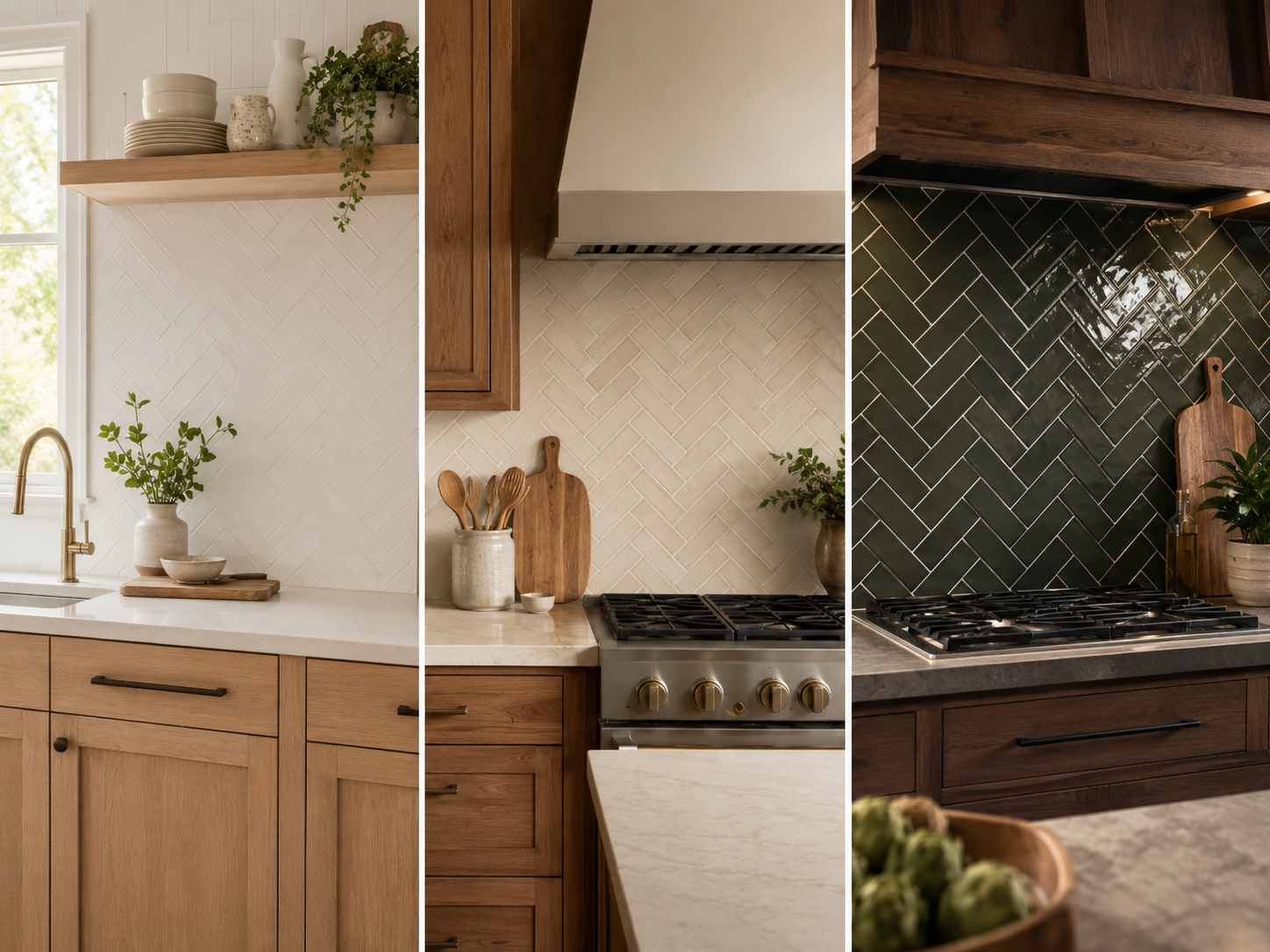
Herringbone tile can be used for kitchen backsplashes, bathroom walls, and flooring.
4.3. Bathrooms
In bathrooms, herringbone tile is often used on the vanity wall, behind a tub, or in the shower.
You do not have to tile the entire room. A single herringbone feature wall, paired with simpler surrounding surfaces, can be enough to create a focal point.
If the pattern is used on the floor, pay extra attention to slip resistance, especially in areas that are frequently wet.
4.4. Bedrooms
Wood-look herringbone tile works well in bedrooms when you want the warmth of wood with a surface that is easier to clean and maintain.
Light brown, beige, and natural wood tones are generally easier to coordinate with beds, casegoods, and window treatments than very dar colors.
4.5. Bar Counters, Coffee Shops, and Retail Stores
In commercial spaces, herringbone is often used on counter fronts, walls behind the counter, or at the entry.
Because these areas are usually moderate in size, they can handle a bolder color or a two-tone mix without overwhelming the space. For floors, prioritize durability and slip resistance because foot traffic is typically heavier than in a home.
5. How to Choose the Right Herringbone Tile Size
Small tiles create a tighter pattern with more grout joints, making them a good fit for backsplashes, vanity areas, or small accent walls.
Medium-size tiles are easier to use across different room sizes. They work on both floors and walls while keeping the herringbone proportions easy to read.
Long plank-style tiles are common with wood-look products. They work well on large floors because they create wider, more open herringbone legs. The substrate needs to be flat enough to minimize lippage where the tiles meet.
6. How to Choose Herringbone Tile Colors by Style
White, cream, and beige tile works well in spaces that need brightness and a lighter feel. Brown wood-look tile is a natural fit for living room or bedroom floors.
Gray and black create stronger contrast and often pair well with glass, metal, and clean-lined interiors. Green, navy, and teal are commonly used in kitchens and bathrooms to create a stronger color statement.
If you choose glossy or metallic-finish tile, use it over a moderate area. The reflective surface combined with the herringbone geometry can create a very strong visual effect.
7. How to Pair Herringbone Tile With Interior Finishes
Wood-look tile pairs well with white or beige walls and other simple, natural finishes. If the floor already has a lot of wood-grain variation, keep large competing patterns in the furnishings to a minimum.
White herringbone tile is easy to pair with wood cabinetry and stone countertops. Gray or black tile can work well with glass, steel, and solid-color finishes.
A simple rule is that once herringbone becomes the focal point, the surrounding surfaces should stay relatively restrained so too many details are not competing for attention.
8. Important Herringbone Tile Installation Notes
Before setting tile, decide exactly which direction the pattern will run. Do not start from an arbitrary corner and try to adjust as you go, because the layout can easily drift off axis.
Establishing the centerline and reference lines is even more important than with a straight lay. If the first few tiles are slightly off, the error can compound across a large installation.
Keep grout joints consistent so the herringbone legs do not look distorted. With wood-look tile, mix pieces from several boxes before installation so similar grain patterns do not end up clustered together.
Herringbone also requires more cuts along walls and at corners. Build an appropriate waste factor into the material quantity, and dry-lay a few rows before permanently setting the tile.
9. What Are the Drawbacks of Herringbone Tile?
Compared with a straight lay, herringbone takes more time to install because the tile installer has to keep checking angles, grout joints, and the pattern axis.
It also requires more cuts, especially in rooms with a lot of corners or columns. That can increase both material waste and labor cost.
Herringbone already has a strong visual presence. If it is combined with too many colors, large-vein stone, or heavily patterned furnishings, the overall design can start to feel busy.
The success of a herringbone installation therefore depends on more than choosing a good-looking tile. Tile size, layout direction, grout color, substrate flatness, and installation quality all affect the finished surface. When those details are planned from the start, herringbone can create a clear focal point on both floors and walls without the need for excessive decoration.